


Seeds of Liberation
An abolitionist installation
Project Site:
Lehigh University Art Galleries, 2025
Manhattan Detention Center
Central California Women’s Facility
Co-Created by:
Dean Caivano
Christina Chi Zhang
Michael Sykes
Clare Fentress
Seeds of Liberation is about prison abolition and how the logic of carceral landscapes can be dismantled through collective acts of care. The work is done in collaboration with Clare Fentress, an architect in New York City, and Dean Caivano, assistant professor of political science and abolition scholar at Lehigh University.
Here, you will find stories about three seeds of liberation.
The first seed grew in the land of Anna d’Angola, one of the first Black women to own land in North America. She received her land in 1647 in today’s lower Manhattan, where a 15-story mega jail is currently being expanded into a 300-foot jail scraper. How did her land of liberation turn into a violent site of confinement? On the wall-mounted map and animation, a seed uncovers the violent memories carried by the soil of Manhattan.
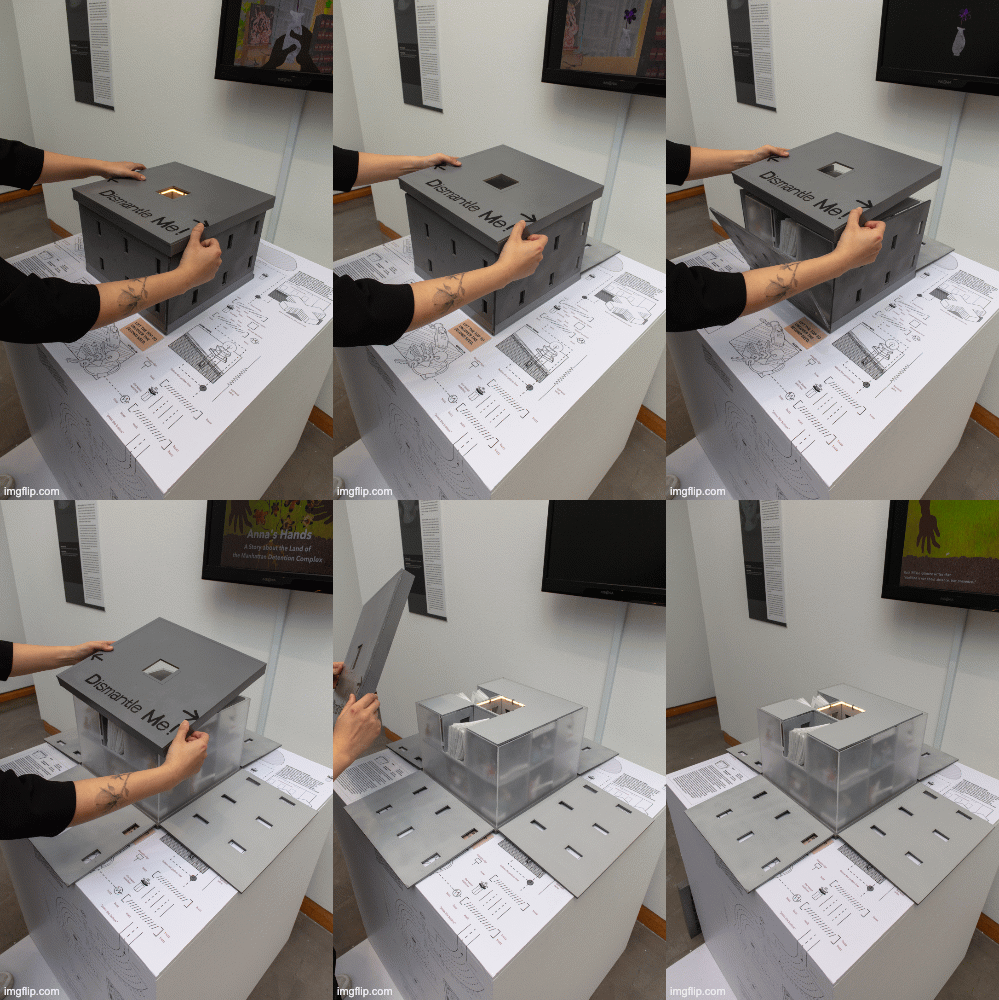
The second seed grows from within the prison walls. An interactive model in the center invites you to dismantle the monolithic walls of incarceration and peek into the life confined by the prison walls of the Central California Women’s Facility. Here, boundaries between criminality and humanity blur: incarcerated individuals are sharing precious moments with each other, writing poems, and living life. In their stories, seeds of liberation take root, germinate, and begin to thrive.
The third seed—a literal seed bomb—is waiting for you to take it home. Inside, it holds seeds of native plants, seeds that yearn to return to Anna d’Angola’s land of care and liberation, seeds that embody a shared commitment to questioning the deep injustices of the prison system, and seeds for imagination and action toward a future society without prisons. Take a seed bomb, and as you do, imagine its sprouts breaking through a concrete wall, transforming confinement into pathways of liberation and hope.


This interactive model leads participants through a geography of violence and a choreography of power, inviting participants to dismantle the structures of carceral architecture to reveal the humanity confined by the monolithic walls of incarceration.
Inspired by Gloria Anzaldúa’s concept of the “in-between,” this model recreates the labyrinthine journey of Dean Caivano, a political theorist and prison educator at the Central California Women’s Facility (CCWF) in California's Central Valley. As the largest women’s correctional facility in the United States, housing over 2,000 incarcerated individuals, CCWF required Dean to navigate a mile-long trek through multiple security checkpoints, encountering symbols and tools of control just to reach the classroom. Yet, along this path and within the classroom, intimate moments of care, dignity, joy, and compassion were experienced despite the dehumanizing practices of incarceration.
We invite you to follow this voyage, navigating a liminal space where an outsider, though technically free, becomes subtly entangled in the prison’s control, surveillance, and discipline network.
The experiences of educators and spectators in the carceral institution are undoubtedly fleeting, with the eventual return to a so-called “free society” awaiting. Yet, what remains within and between these spaces of humanity reveals visions of a qualitatively different kind of society.
Within these in-between spaces—enclaves shaped by a monopoly of violence—the boundaries between criminality and humanity blur. The scenes recreated here emerged through shared moments of care during the opening of each class session. In those precious minutes, students formed a community, getting to know one another in a way that transcended the confines of the yard or housing units. This process provided a much-needed reprieve, a space to breathe, and powerful poems—like those of student Michael Sykes, featured here—to emerge. From within these spaces, seeds of liberation take root, germinate, and begin to thrive.
Photographers: Luqmaan Shaikh, Holly Fasching
Model-Making Assistant: Brian Sreng